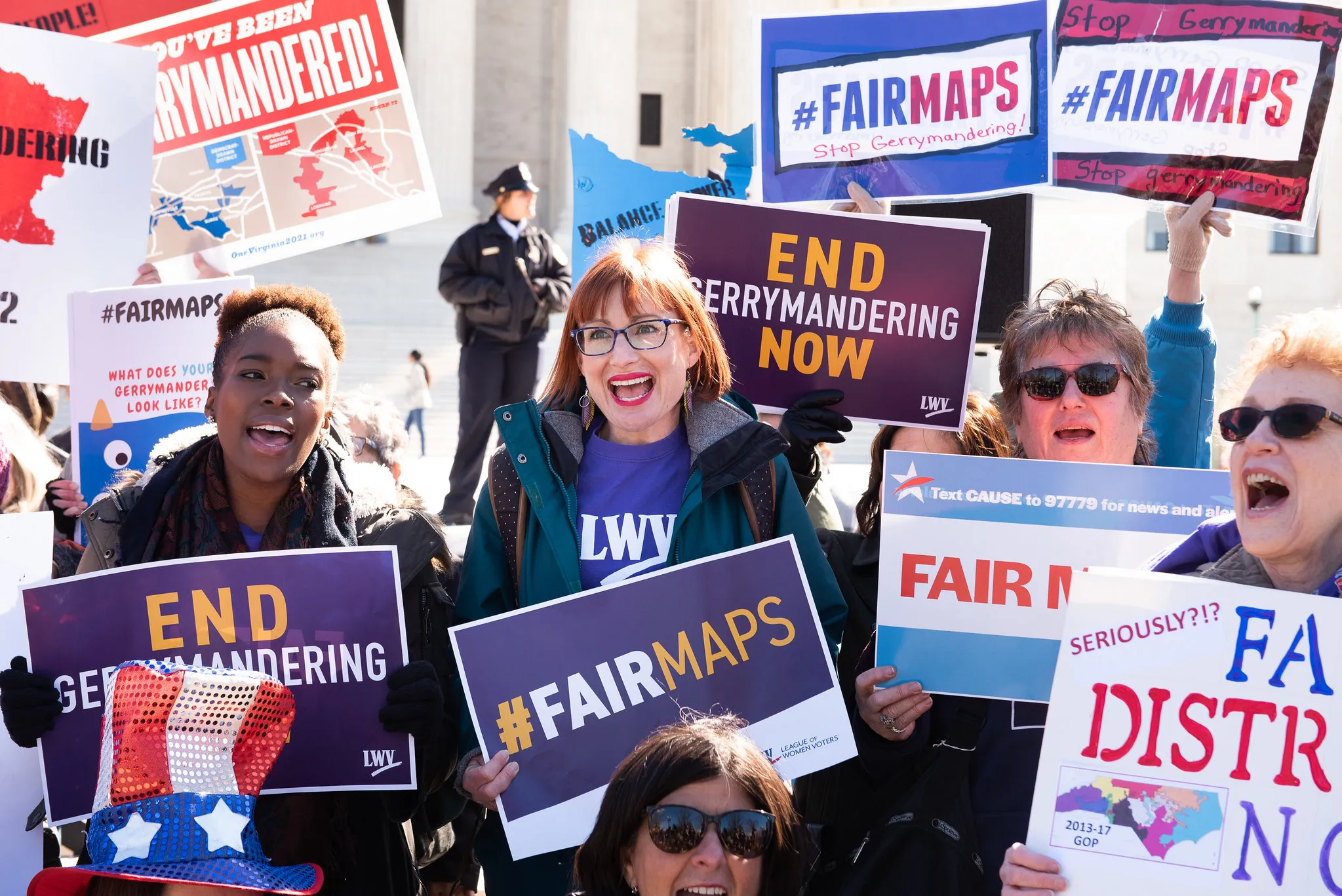
In the Buckeye State, a political storm is brewing as Ohio prepares for redistricting, drawing inspiration from dramatic events in Texas where Democrats fled the state to block a quorum and halt the approval of a map that would weaken their positions in several key districts. This process, set to begin this month, could shape not only Ohio's political landscape but also impact the national battle for control of the U.S. House of Representatives ahead of the 2026 elections.
Ohio Democrats, inspired by the tactics of their Texas colleagues, are gearing up for a fierce confrontation. In Texas, Democratic legislators left the state to block a quorum and prevent the passage of a map that would have weakened their hold in several key districts. “What started in Texas doesn’t end there,” said Ohio State Representative Erik Sinenberg, a Democrat from Bixwood, during a rally outside the Statehouse in Columbus. “Ohio is the next battleground.”
Sinenberg, along with other Democrats, claims that Republicans seek to manipulate district boundaries to entrench their narrow advantage in the U.S. House, where Ohio is currently represented by 10 Republicans and 5 Democrats. “They want to make the maps less fair,” Sinenberg said. “This will give Republicans disproportionately more chances to hold onto power.”
Republican Strategy: Ambitions and Promises of Fairness
Republicans controlling Ohio’s Redistricting Commission insist on their commitment to a transparent process. Assistant House Majority Leader Adam Bird, a Republican from New Richmond, assures that national political battles will not influence Ohio’s decisions. “We’re not chasing a particular outcome,” Bird said. “Our task is to follow Ohio’s Constitution.”
However, leaders of the Republican Party, such as Vice President J.D. Vance and party chair Tony Scherder, do not hide their ambitions. They see redistricting as a chance to strengthen GOP positions in Congress. “Control of the House is key,” Scherder said. “A larger margin in votes means it’s easier to push our agenda.” Their goal is to redraw the boundaries of three districts currently held by Democrats: Emily Sykes (District 13), Marcie Kaptur (District 9), and Greg Landsman (District 1).
Ohio’s Uniqueness: Restrictions for Democrats
Unlike Texas, where Democrats could halt the process by leaving the state, such tactics are not possible in Ohio. State law does not allow blocking voting through a lack of quorum, and the Republican-controlled commission has the final say if no bipartisan agreement is reached. Ohio law prohibits obvious manipulations of district boundaries, but Republicans point to the proportionality of the current map to recent election results, including Donald Trump’s significant victory in Ohio in 2024 (55% versus Kamala Harris’s 44%).
U.S. Senator Bernie Moreno, a Republican, expressed the view that a 12-3 split in favor of Republicans would fairly reflect the state’s electoral sentiments. However, not all party leaders share this position. Lieutenant Governor Jim Tressel, whom I caught in the hallway on Thursday, avoided specifics. “Is 12-3 fair? You know, I can’t really comment on that,” he said, smiling. When I asked if the lieutenant governor should know the composition of the state delegation, Tressel joked: “Probably. You just checked me, and I learned something new — that’s great.”
The Voter’s Voice or a Political Game?
Democrats emphasize that even the current 10-5 distribution does not fairly reflect voters’ will. “It’s already unfair,” Sinenberg said. “Any further shifting will only undermine democracy further.” They find hope in statements by Governor Mike DeWine’s administration, which underlines the importance of considering voters’ voices. Yet, skepticism remains: the previous 2022 map was declared unconstitutional due to a lack of bipartisan agreement, and the current process risks repeating the same scenario.
Ohio lawmakers must complete a new map by the end of November, and House Speaker Matt Hoffman promised the initial draft will appear as early as this month. As both sides prepare for confrontation, Ohio becomes a microcosm of the broader national fight for democracy, where the boundaries of electoral districts may determine whose voice is heard in Washington.